
How Long After Tooth Extraction Can You Get a Dental Implant?
Losing a tooth can be stressful, especially when you’re thinking about what comes next. If your dentist has recommended a tooth extraction, one of the first questions you may have is: “How long after tooth extraction can I get a dental implant?”
The answer isn’t the same for everyone. Some patients may be candidates for an implant on the same day as the extraction, while others may need to wait several weeks or months for the extraction site and surrounding bone to heal. In some situations, a bone graft may also be recommended before an implant can be placed.
The timing depends on factors such as the condition of the tooth and gums, the presence of infection, the amount of healthy jawbone available, and your overall oral health.
If you’re considering replacing a missing tooth, understanding the different stages can make the process feel much less complicated. At Arlington Dental in Toronto, dental implants are used to restore the appearance and function of missing teeth, with treatment planned according to each patient’s individual needs.
Can You Get a Dental Implant Immediately After Tooth Extraction?
In some cases, yes.
An immediate dental implant is placed during the same appointment as the tooth extraction. Instead of removing the tooth, allowing the socket to heal completely, and then placing an implant later, the dentist may place the implant directly into the extraction site.
However, immediate implant placement isn’t suitable for every patient.
Your dentist needs to evaluate the condition of the tooth, surrounding tissues, jawbone, and gums before deciding whether immediate placement is appropriate. If there is significant infection, insufficient bone, or other concerns, waiting may provide a safer and more predictable treatment pathway.
This is why the answer to “how soon can I get a dental implant after extraction?” should always be based on an individual dental examination rather than a fixed timeline.
How Long Do You Usually Have to Wait After an Extraction?
When an immediate implant isn’t appropriate, your dentist may recommend allowing the extraction area to heal before implant placement.
The healing period can vary considerably.
For some patients, implant placement may be possible after several weeks of soft-tissue healing. For others, the dentist may recommend waiting several months to allow more extensive bone healing.
The exact timeline depends on the condition of the extraction site and whether additional treatment, such as bone grafting, is required.
Arlington Dental explains that dental implant treatment is performed in stages and that the jawbone needs time to heal and integrate with the implant.
So rather than thinking of dental implant treatment as one procedure, it is helpful to think of it as a process with several stages.
Why Can’t Everyone Get an Implant Right Away?
A dental implant needs adequate bone and healthy surrounding tissues to provide stable support.
When a tooth is removed, the bone that previously supported the tooth no longer receives the same stimulation. Over time, changes in the shape and volume of the jawbone can occur.
If there isn’t enough healthy bone available to support an implant, your dentist may recommend a bone graft.
Bone grafting can add another stage to the treatment process. The graft needs time to heal and develop sufficient strength before implant placement can proceed.
Arlington Dental notes that bone grafting may be necessary when there isn’t enough jawbone to provide appropriate support for an implant.
This is one reason why an implant consultation before or around the time of extraction can be helpful.
What Happens If You Have an Infection?
An infected tooth doesn’t automatically mean you cannot eventually receive a dental implant.
However, the infection and surrounding tissues need to be carefully evaluated and managed.
Depending on the situation, your dentist may recommend treating the infection, removing the tooth, allowing the area to heal, and then reassessing the site before implant placement.
The timing can therefore be different for someone who has a straightforward extraction compared with someone who has significant infection or bone loss.
Arlington Dental’s extraction service notes that extraction may sometimes be necessary when a tooth cannot be predictably preserved, while the practice also offers dental implants for replacing missing teeth.
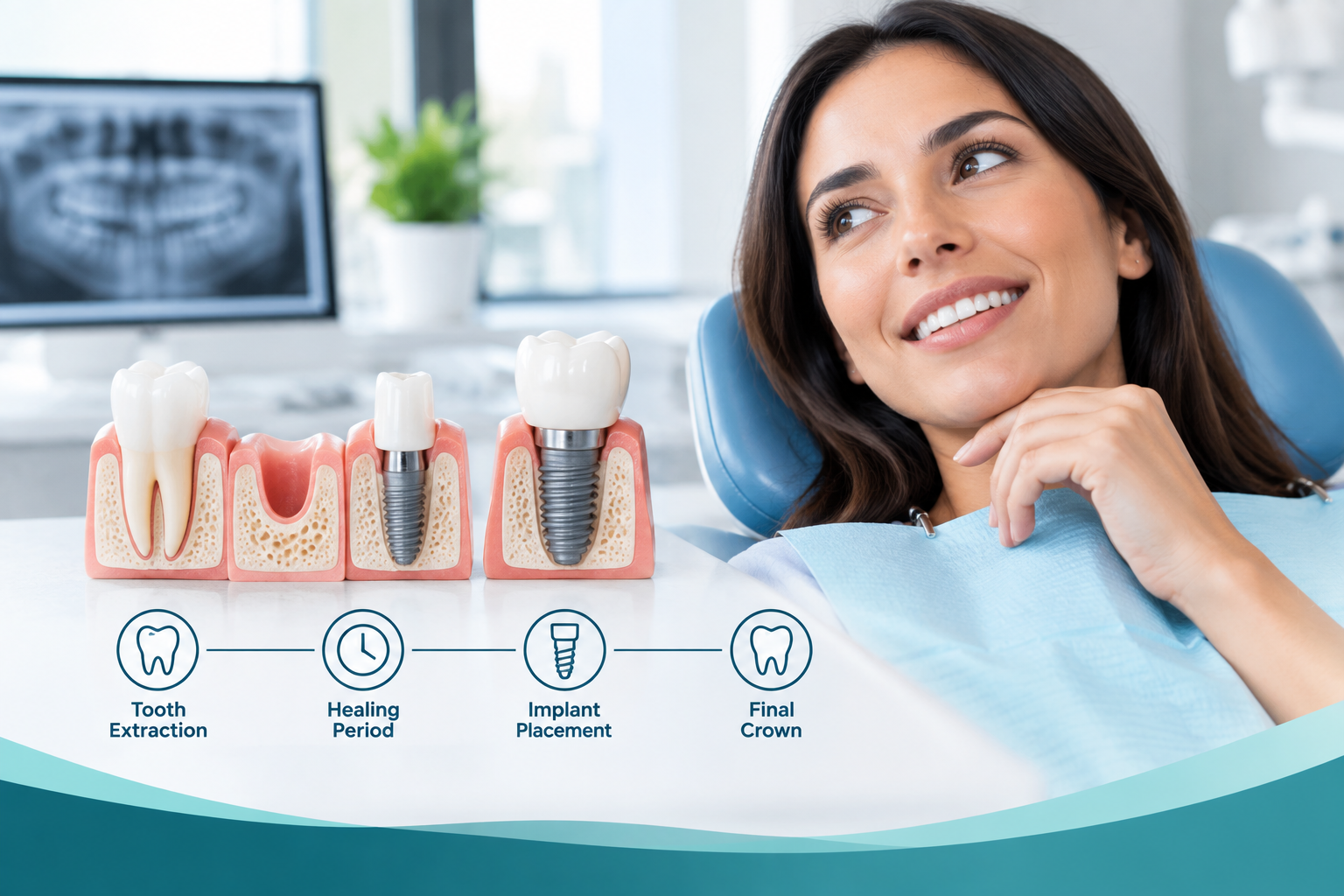
What Is the Dental Implant Process After Tooth Extraction?
Although every treatment plan is different, the process generally involves several stages.
1. Dental Examination and Treatment Planning
The first step is an examination of your mouth and the area where the tooth is missing.
Your dentist will assess the condition of the gums and bone and determine whether an implant is appropriate.
The treatment plan may also consider whether you need a bone graft or another procedure before implant placement.
2. Tooth Extraction
If the tooth is still present, it may need to be removed.
The extraction itself can be relatively straightforward or more complex depending on the tooth’s condition and position.
Arlington Dental provides both routine tooth extractions and surgical extractions when required.
3. Healing or Bone Grafting
If immediate implant placement isn’t appropriate, the extraction site may need time to heal.
If bone volume is insufficient, bone grafting may be recommended before moving forward with the implant.
4. Implant Placement
Once the site is considered suitable, the dental implant is placed into the jawbone.
The implant acts as an artificial tooth root.
5. Osseointegration
After placement, the implant needs time to integrate with the surrounding bone.
This process is called osseointegration.
It is an important stage because the implant needs to become firmly supported by the jawbone before the final restoration is attached.
6. Final Tooth Restoration
Once the implant has sufficiently integrated, the final artificial tooth can be attached.
The result is designed to restore both the appearance and function of the missing tooth.
Arlington Dental describes its implant process as involving multiple appointments and healing stages, with treatment planned around each patient’s individual needs.
How Long Does the Entire Dental Implant Process Take?
This is another question patients commonly ask.
There isn’t one universal answer.
For some patients, the process can move relatively quickly. Others may require several months because of healing, bone grafting, or other treatments that need to be completed first.
The important thing to remember is that healing time is part of the treatment, not an unnecessary delay.
Your dentist needs to make sure the implant has adequate support before proceeding to the next stage.
Trying to rush the process isn’t necessarily beneficial. A carefully planned treatment can help create a stable foundation for the final restoration.
What If You Wait Too Long After Tooth Extraction?
Some people put off replacing a missing tooth because they aren’t experiencing pain anymore.
Unfortunately, the absence of pain doesn’t mean that nothing is changing.
After tooth loss, the surrounding teeth can shift into the empty space. Arlington Dental notes that missing teeth can allow neighbouring teeth to move and create additional areas where food and bacteria can become trapped.
Changes in the jawbone can also occur after tooth loss.
This doesn’t mean that an implant becomes impossible if you’ve had a missing tooth for years. However, additional evaluation or procedures may sometimes be needed before an implant can be placed.
If you’ve already had a tooth extracted and haven’t replaced it, it’s worth discussing your options with a dentist.
Can You Get an Implant Months or Years After Extraction?
Yes, having a tooth removed months or even years ago does not automatically mean you cannot have a dental implant.
However, the condition of the bone and gums needs to be assessed.
If bone has reduced significantly since the extraction, your dentist may discuss bone grafting or other treatment options.
An implant consultation can help determine what is possible and whether additional preparation is required.
Arlington Dental offers dental implants as a missing-tooth replacement option and also provides other solutions, including bridges and partial dentures, depending on the patient’s circumstances.
Dental Implant vs. Leaving the Gap
It can be tempting to leave a missing tooth alone, particularly if it isn’t visible when you smile.
But a missing tooth can affect more than appearance.
Depending on its location, it may affect chewing, speech, bite balance, and the position of nearby teeth.
A dental implant is one option for replacing a missing tooth because it is designed to function as an artificial tooth root.
Other replacement options may include a dental bridge or partial denture.
Your dentist can explain the advantages and limitations of each option based on your oral health, preferences, and treatment needs.
What Factors Affect Dental Implant Timing?
Your implant timeline may depend on several factors, including:
- Condition of the extraction site
- Amount of available jawbone
- Presence of infection
- Health of your gums
- Need for bone grafting
- Type and location of the missing tooth
- Your general oral health
- Healing after extraction
- Your individual treatment plan
This is why two patients who have teeth extracted on the same day may have completely different implant timelines.
There is no single waiting period that applies to everyone.
How Can You Prepare for a Dental Implant?
If you know that an extraction is necessary and you are considering an implant afterward, talk to your dentist before the extraction whenever possible.
Planning ahead gives your dental team an opportunity to evaluate the tooth and surrounding bone and consider the eventual replacement.
You can also ask:
- Could I be a candidate for an immediate implant?
- Will I need a bone graft?
- How long might healing take?
- What replacement options are available?
- What will happen after the implant is placed?
- How long could the complete process take?
Having these conversations early can help you understand what to expect.
What Should You Do After Tooth Extraction?
Following your dentist’s post-extraction instructions is important.
Arlington Dental recommends personalized aftercare following extraction and provides patients with instructions designed to support a smooth recovery.
Generally, patients are advised to protect the extraction site while it heals and follow their dentist’s instructions regarding eating, cleaning, activity, and medications.
Contact your dental office if you experience symptoms that concern you, such as severe or worsening pain, significant bleeding, increasing swelling, fever, or other signs of possible complications.
A healthy healing site is an important part of planning for future tooth replacement.
When Should You Talk to a Dentist About a Dental Implant?
If you’re having a tooth extracted and are considering an implant, it’s a good idea to discuss replacement options before or soon after the extraction.
You don’t necessarily need to wait until the tooth has been removed to start planning.
A consultation can help determine whether immediate implant placement is possible or whether your mouth needs time to heal first.
If you’re looking for dental implants in Toronto, Arlington Dental provides implant treatment at its St. Clair West location and creates treatment plans based on individual patient needs.
Learn more about Dental Implants at Arlington Dental
Final Thoughts
So, how long after tooth extraction can you get a dental implant?
The answer could be the same day, several weeks later, or several months later, depending on your individual circumstances.
Immediate implant placement may be possible for some patients, while others may need additional healing or bone grafting before an implant can be placed. Once the implant is placed, additional healing is required for the implant to integrate with the jawbone before the final restoration is completed.
The best way to determine your timeline is through a professional examination and personalized treatment plan.
If you’re planning a tooth extraction and already know you want to replace the tooth, don’t wait until after the extraction to ask about implants. Discuss your options with your dentist beforehand so the extraction, healing period, and tooth replacement can be considered as part of one overall treatment plan.
For patients in Toronto, St. Clair West, Bathurst, and surrounding neighbourhoods, Arlington Dental provides tooth extraction and dental implant services from its clinic at 798 St. Clair Avenue West, Toronto.